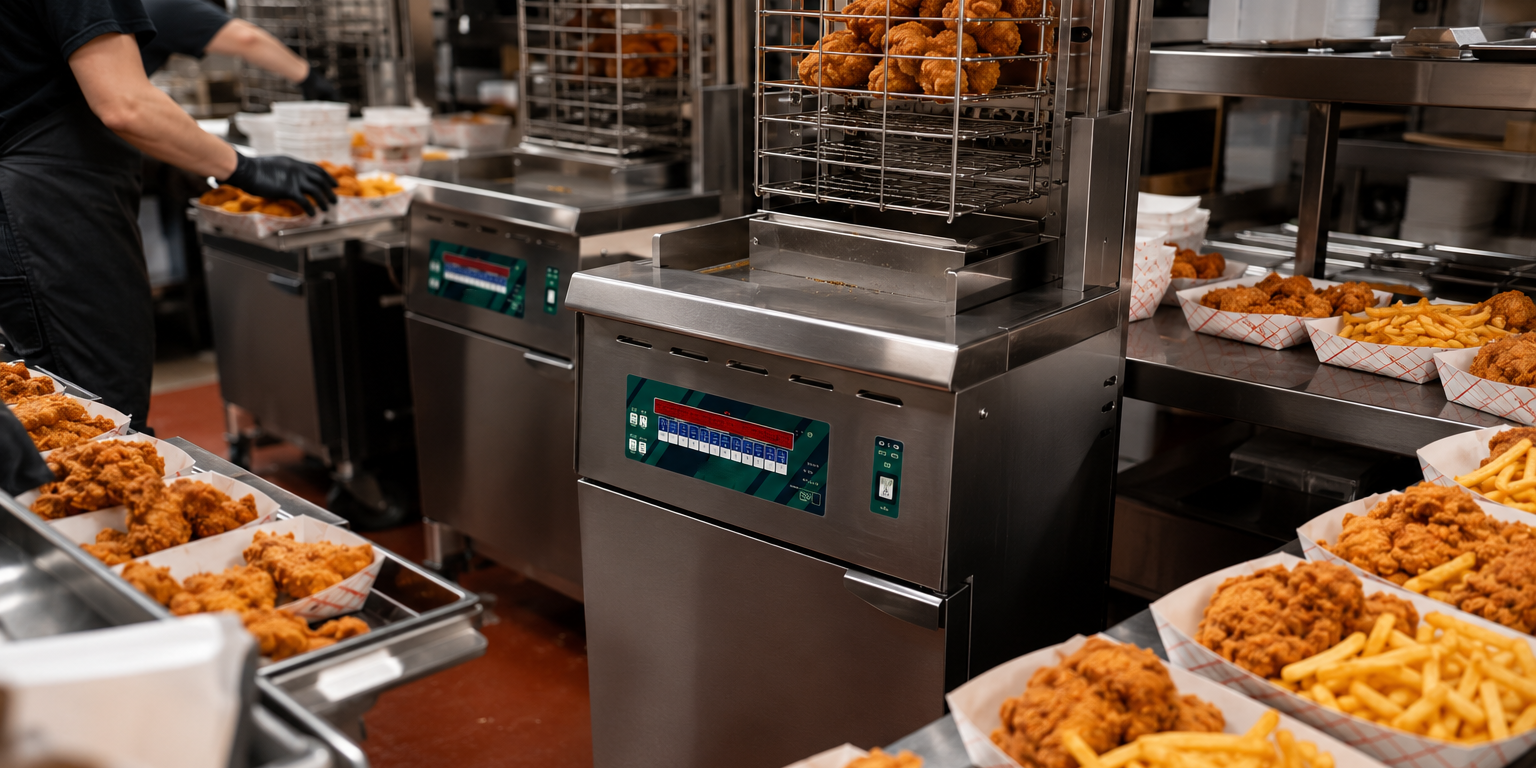
In modern commercial kitchens, fried chicken is not only about flavor. It is also about consistency, oil management, production efficiency, operator safety, and daily maintenance. For restaurants, chain stores, food courts, and takeaway kitchens, a reliable commercial pressure fryer can help produce juicy, crispy, and consistent fried chicken while supporting a more standardized kitchen workflow.

This pressure fryer is designed for professional foodservice operations that need stable frying performance, practical oil filtration, programmable cooking control, and durable food-contact construction. With options for both small-to-medium production and high-volume kitchens, it provides a complete frying solution for businesses that want to improve product quality and operating efficiency.

Why Pressure Frying Matters in Commercial Kitchens

Pressure frying is widely used for fried chicken because it helps lock moisture inside the product while cooking the outside to a crisp finish. Compared with ordinary open frying, pressure frying can help kitchens produce tender meat, attractive color, and more consistent results during repeated cooking cycles.

For commercial operators, the real value of a pressure fryer is not only the cooking result. A good machine should also help reduce daily operation problems, such as unstable oil quality, residue burning, difficult filtration, slow cleaning, inconsistent recipes, and operator workload during peak hours.

Cold Zone Frypot Design for Cleaner Oil and Better Frying Consistency

One of the key design features of this pressure fryer is the cold-zone frypot structure. During frying, small food particles and breading crumbs naturally fall from the product. If these particles stay in the high-temperature heating area, they can burn quickly, darken the oil, affect flavor, and reduce oil life.

The cold zone and sediment area help keep food particles away from the main heating zone. The lower-temperature area at the bottom of the frypot slows residue carbonization and supports cleaner frying over repeated cycles. For restaurants that fry chicken continuously throughout the day, this structure can help maintain more stable oil quality and more consistent product appearance.

Cold Zone Structure

Helps separate falling food particles from the main heating area, reducing the chance of residue burning during continuous frying.

Sediment Area

Collects crumbs and frying residue at the bottom of the frypot, supporting cleaner oil and easier daily maintenance.

Oil-Melting Function for Solid Shortening

Many commercial kitchens use solid shortening for frying. However, solid oil requires careful heating at startup. Heating too aggressively can affect the oil, damage components, or create unnecessary safety risks.

This pressure fryer includes a solid shortening oil-melt function. It gradually liquefies shortening at startup, making daily preparation easier and safer for operators. Combined with oil-melting temperature sensing and high-limit protection, the fryer provides more controlled heating during the startup process.

For kitchens that use solid shortening, the oil-melt function is especially useful. It reduces manual handling, improves startup convenience, and supports safer heating control before normal frying begins.

Programmable Control for Standardized Cooking

Consistency is one of the biggest challenges in fried chicken production. Different operators may cook with slightly different timing, temperature, or pressure-release habits. Over time, this can lead to inconsistent product quality between shifts or between stores.

The 8-chicken model supports 12 programmable menus. Each menu can be configured with up to 9 cooking stages, including temperature, time, and pressure release settings. This allows chain kitchens and busy restaurants to standardize recipes and reduce dependence on individual operator experience.

  • 12 programmable cooking menus for the 8-chicken model.
  • Up to 9 stages per menu for temperature, time, and pressure release.
  • Configurable temperature units based on operating requirements.
  • Filtration cycle limits can be set according to kitchen management needs.
  • Forced filtration lockout can require oil filtration after a preset number of cycles.

For chain restaurants, this programmable control system helps ensure that each batch follows the same cooking logic. It also makes staff training easier because operators can follow preset programs instead of manually adjusting every cooking parameter.

Forced Filtration Management for Better Oil Discipline

Oil quality directly affects fried chicken color, flavor, texture, and operating cost. In many kitchens, filtration is delayed during busy hours because staff want to continue production. Over time, this can lead to darker oil, inconsistent food quality, and higher oil consumption.

The forced filtration lockout function helps solve this problem. After a preset number of frying cycles, the fryer can require oil filtration before operation continues. This supports standardized kitchen management and helps teams maintain better oil care habits.

For high-volume stores, this feature is valuable because it turns oil filtration from a “manual reminder” into a built-in operating process. It helps managers maintain consistent oil quality across shifts and reduces the chance that filtration is skipped.

Flat Heating Tubes for Efficient Heat Transfer

Heating performance is another important factor in commercial frying. A fryer must recover temperature quickly after food is loaded, especially during peak service. Stable heating helps maintain product texture, color, and cooking time.

This pressure fryer uses flat heating tubes designed for efficient heat transfer, higher power output, and longer service life compared with conventional round-tube layouts. The heating tube layout works together with the frypot structure to support stable frying performance during repeated production.

Stable Pressure Control and Safety Protection

Pressure frying requires reliable pressure control. This machine uses dual pressure protection through a pressure gauge and weighted pressure control. This helps support stable operation and gives operators a clearer view of the machine’s pressure condition during cooking.

An optional pressure-boosting function is also available. This feature can help maintain cooking pressure and product texture when frying smaller batches. For kitchens that sometimes cook below full load, this can help improve batch consistency.

Important Safety-Related Features

  • High-limit protection for safer heating control.
  • Oil-melting temperature sensing during startup.
  • Drain valve safety interlock to reduce dry-heating risk.
  • Reset switch after dry-heating protection is triggered, subject to operator inspection.
  • Oil pump self-protection, including pressure protection and motor overload protection.

The drain valve safety interlock is especially important. When the drain valve is open, heating and controller operation are prevented. This helps reduce the risk of dry heating and supports safer daily operation.

Quick-Connect Filtration System for Easier Maintenance

Oil filtration is necessary, but it should not slow down the kitchen. Traditional filtration systems can require more manual tightening, positioning, or handling. If the process is too complicated, operators may avoid doing it during busy service.

This pressure fryer uses a quick-connect filter cart design. It reduces manual tightening steps and makes filtration faster, easier, and safer. The filtration valve can also be linked with the motor, allowing filtration to start directly when the valve is opened.

The mobile filter cart is equipped with wheels, making it easy to remove, move, and clean. This is practical for commercial kitchens where cleaning speed and space efficiency matter.

Quick-Connect Filter Cart

Simplifies filtration setup, reduces manual operation, and helps shorten downtime between frying cycles.

Mobile Design

The filter cart with wheels is easy to move, remove, and clean, supporting faster daily maintenance.

Oil Pipe Heating Belt

Helps melt residual shortening after startup and reduces the risk of overnight oil-line blockage.

Water Collection Box

Collects condensed steam water, making daily cleaning more convenient for operators.

Service-Friendly Design for Commercial Use

In a busy kitchen, equipment should be easy to inspect and maintain. This pressure fryer includes side service access panels, allowing easier maintenance of the oil pump and electrical box. This service-friendly structure can help reduce maintenance time and make routine inspection more convenient.

The recommended cleaning method is to clean the frypot with oil rather than washing the vessel with water. This helps protect the machine structure and supports proper maintenance for pressure frying equipment.

Durable Construction and Food-Contact Materials

Durability and food safety are essential for commercial frying equipment. The food-contact areas of this pressure fryer use 304 stainless steel for durability and easier cleaning. The pressure lid cover and internal food-contact surfaces are also specified as 304 stainless steel.

The pressure lid uses a cast aluminum structure, providing a robust lid assembly with smooth lifting action. This helps reduce operator effort during repeated daily opening and closing. The side panels use 430 stainless steel, while the rear panel uses galvanized sheet according to the product material specification.

Layered Rack System for Flexible Product Loading

The fryer can be configured with layered racks for different products and cooking formats. This is useful for fried chicken production because it helps organize product loading inside the frypot and supports more consistent batch results.

The rack system may be customized as needed, making the fryer suitable for different menu structures, product sizes, and kitchen production requirements.

4-Chicken Pressure Fryer: Compact and Practical for Daily Production

The 4-chicken pressure fryer is designed for small to medium-volume foodservice operations. With a 24 L oil capacity, it is suitable for compact commercial kitchens, restaurants, cafes, food trucks, takeaway shops, and stores with moderate fried chicken demand.

Main Advantages of the 4-Chicken Model

  • 24 L oil capacity for compact commercial kitchens.
  • Cold zone and sediment area help reduce residue carbonization.
  • Oil-melting function supports solid shortening startup.
  • High-limit protection supports safer operation.
  • Smooth pressure lid lifting reduces operator effort.
  • Customizable layered rack design supports different product formats.
  • Quick-connect filter cart simplifies filtration setup and reduces downtime.

For operators who need professional pressure frying performance but do not require very large capacity, the 4-chicken model offers a practical balance between footprint, oil capacity, and daily productivity.

8-Chicken Pressure Fryer: Built for High-Volume Frying

The 8-chicken pressure fryer is designed for busy commercial kitchens and chain-store production. With a 55 L oil capacity, it supports higher output during peak service and provides more advanced programmable cooking control.

Main Advantages of the 8-Chicken Model

  • 55 L large oil capacity for busy kitchens and chain-store production.
  • 12 programmable menus for standardized cooking.
  • Each menu supports up to 9 stages for temperature, time, and pressure release.
  • Forced filtration lockout helps maintain oil quality and kitchen discipline.
  • Flat heating tubes support efficient heat transfer and stronger heating power.
  • Quick-connect oil filtration system improves filtration efficiency and operating safety.
  • Mobile filter cart with wheels is easy to remove, move, and clean.
  • Optional pressure-boosting function helps maintain pressure and product texture with smaller batches.

For high-volume operators, the 8-chicken model provides stronger production capacity and better recipe management. It is especially suitable for fried chicken restaurants, quick-service restaurants, central kitchens, and chain stores that need consistent output across different shifts.

4-Chicken vs. 8-Chicken Pressure Fryer

Item 4-Chicken Pressure Fryer 8-Chicken Pressure Fryer
Oil Capacity 24 L 55 L
Best For Small to medium-volume restaurants and compact kitchens High-volume restaurants, chain stores, and peak-hour production
Cooking Control Practical daily pressure frying operation 12 programmable menus with up to 9 cooking stages per menu
Oil Management Cold zone, sediment area, oil-melting function, and quick-connect filtration Cold zone, forced filtration lockout, quick-connect filtration, and large-capacity oil management
Maintenance Quick-connect filter cart and service-friendly structure Mobile filter cart, side service access, and advanced filtration management
Recommended Users Restaurants with steady but moderate fried chicken demand Restaurants and chain kitchens with high production requirements

Who Should Use This Commercial Pressure Fryer?

This pressure fryer is suitable for a wide range of foodservice businesses that need consistent fried chicken production and better oil management.

  • Fried chicken restaurants
  • Quick-service restaurants
  • Takeaway kitchens
  • Food courts
  • Hotel and catering kitchens
  • Central kitchens
  • Chain-store kitchens
  • Commercial kitchens using solid shortening

For smaller stores, the 4-chicken model provides a compact and practical solution. For larger stores or chains, the 8-chicken model offers stronger capacity, programmable control, and better standardized management.

Key Benefits for Kitchen Operators

More Consistent Product Quality

Programmable cooking control and stable pressure management help reduce differences between operators and shifts.

Better Oil Management

Cold zone design, sediment area, and forced filtration management help support cleaner oil and repeated frying consistency.

Improved Operating Efficiency

Quick-connect filtration, mobile filter cart, and easier maintenance help reduce downtime during daily operation.

Safer Daily Operation

High-limit protection, drain valve safety interlock, pressure protection, and motor overload protection support safer use.

Conclusion: A Reliable Pressure Frying Solution for Professional Kitchens

A commercial pressure fryer should help kitchens do more than simply fry chicken. It should support consistent cooking, better oil quality, easier filtration, safer operation, and more efficient daily maintenance.

This pressure fryer combines a cold-zone frypot structure, solid shortening oil-melt function, programmable cooking control, forced filtration management, quick-connect filtration, durable food-contact materials, and service-friendly access. Whether used in a compact restaurant or a high-volume chain kitchen, it is designed to help operators produce better fried chicken with more control and less daily hassle.

For businesses looking to improve fried chicken quality and streamline kitchen operation, this pressure fryer provides a practical and professional solution.

Looking for a Commercial Pressure Fryer for Your Kitchen?

Choose the right model based on your production volume, kitchen space, menu structure, and oil management requirements. The 4-chicken model is ideal for compact kitchens and medium-volume production, while the 8-chicken model is better suited for busy restaurants, chain stores, and high-output fried chicken operations.